
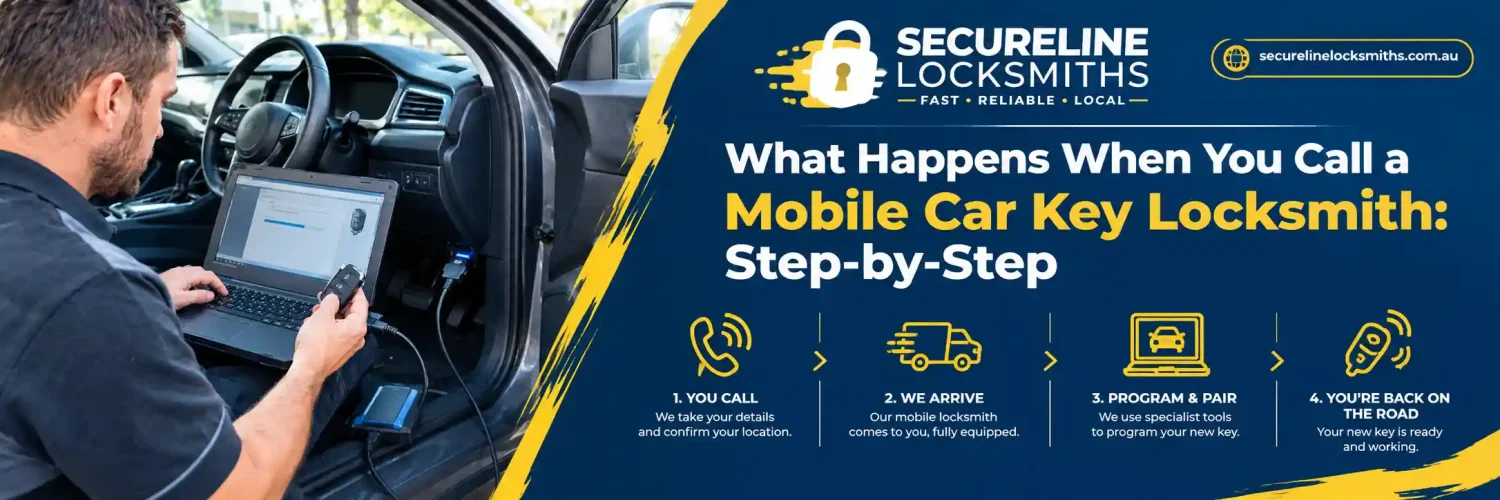
Calling a mobile car key locksmith for the first time comes with a fair amount of uncertainty — what actually happens, how long it takes, what you need to have ready. Walking through the whole process from the initial call through to driving away again removes most of that uncertainty, so you know exactly what to expect before you’ve even picked up the phone.
Before They Arrive: The Call Itself
The process starts with a phone call where you’ll be asked a handful of practical questions: your vehicle’s make, model, and approximate year, whether you have any working key remaining or have lost every key entirely, and your current location. These details matter because they determine what equipment the technician brings — vehicles vary considerably in their key systems, from basic mechanical keys to sophisticated transponder and proximity fob systems, and arriving with the wrong equipment simply wastes everyone’s time.
You’ll also typically be asked about proof of ownership, since a responsible locksmith won’t cut or program a key for a vehicle without reasonable confirmation you’re actually authorised to have one made. Having your driver’s licence and vehicle registration details on hand at this stage, ready to reference, smooths this part of the conversation considerably.
What to Have Ready Before You Call
Your vehicle’s registration plate, the VIN if you can locate it, and identification matching the vehicle’s registered owner all speed up the verification process once a technician arrives.
While You Wait: What’s Actually Happening on Their End
Once your call is confirmed, the locksmith is typically sourcing or preparing the correct key blank for your specific vehicle, since not every technician carries every possible blank for every make and model as standard stock. For common vehicles, this is usually already on hand. For less common or older vehicles, there may be a short additional wait while the correct blank or transponder chip is located.
This is also when programming equipment gets prepared, if your vehicle requires it. Modern vehicles with transponder chips need the new key’s chip programmed to match your specific vehicle’s immobiliser system — without this step, a mechanically correct key still won’t actually start the car, since the vehicle’s computer won’t recognise it as authorised.
On Arrival: The Initial Assessment
When the technician arrives, the first step is usually a quick visual assessment of your specific situation — confirming the vehicle, checking whether it’s a straightforward lost key situation or something more complex like a broken key fragment needing extraction first. This assessment also confirms the equipment brought matches what’s actually needed, catching any mismatch early rather than partway through the job.
If a broken key fragment is involved, extraction happens at this stage, using specialised tools designed specifically for removing fragments without damaging the surrounding lock or ignition mechanism. This step typically takes only a few minutes for a standard extraction.
The Cutting and Programming Process
For a straightforward lost key situation, the technician cuts a new key to match your vehicle’s lock specifications, either working from your vehicle’s ignition or door lock directly, or from manufacturer data matched to your specific vehicle’s identification details. For vehicles with transponder or proximity systems, programming follows the physical cutting — connecting to your vehicle’s onboard diagnostic system to register the new key or fob as authorised.
This combined process, for most standard vehicles, takes somewhere between twenty minutes and an hour, depending on the complexity of your specific vehicle’s system and whether any complications — like a genuinely unusual key blank requirement — arise along the way.
What Determines How Long This Actually Takes
Common, mainstream vehicles with straightforward transponder systems are typically the fastest to handle, since the equipment and blanks required are standard stock. Less common vehicles, older models with specific quirks, or proximity fob systems requiring more involved programming steps can extend the process somewhat.
Testing Before They Leave
A responsible technician won’t consider the job finished until the new key has been properly tested — starting the vehicle, checking that all functions the key or fob should control (central locking, alarm deactivation, immobiliser recognition) actually work as expected. This testing step matters considerably, since a key that appears correctly cut and programmed but hasn’t actually been verified against your specific vehicle can still fail in ways that only become apparent once you’re relying on it later, potentially at a genuinely inconvenient moment.
Wrapping Up: What Happens at the End of the Visit
Once testing confirms everything works properly, the technician will typically walk you through anything relevant about your new key — whether it’s a straightforward mechanical key needing no special handling, or a fob requiring battery replacement guidance down the track. If your situation involved a lost rather than broken key, this is also a reasonable point to discuss whether deactivating the lost key’s transponder code is worth doing, addressing any lingering security concern about the missing original.
Payment and any documentation of the work completed typically happen at this stage too, before the technician heads off to their next callout.
What Can Extend or Complicate the Process
A handful of situations can genuinely extend the straightforward version of this process described above. A vehicle model the technician hasn’t encountered before might require a brief additional diagnostic step to confirm the correct approach.
A particularly high-security vehicle system might exceed standard mobile locksmith equipment capability entirely, in which case a technician should tell you this honestly rather than attempting a job their equipment genuinely can’t complete properly. Multiple keys needed at once — replacing an entire set rather than a single lost key — naturally takes longer than a single-key job, simply due to the additional cutting and programming involved.
How This Compares to a Standard House Lockout Callout
It’s worth understanding how a car key job differs from a more familiar house lockout callout, since the two involve genuinely different processes despite both falling under mobile locksmith services. A house lockout is primarily about entry — getting a door open without damage — and typically resolves in under half an hour once someone’s on site. A car key job, particularly one involving programming, is closer to a manufacturing and configuration task, which is why it generally takes longer even though both scenarios might feel equally urgent to the person waiting.
Understanding this distinction helps set realistic expectations from the outset, rather than assuming every mobile locksmith callout follows an identical timeline regardless of what’s actually involved.
What If You’re Not Actually Sure What’s Wrong With Your Key?
Sometimes the situation isn’t a clean “lost” or “broken” scenario — a key might be technically present but simply not working anymore, for reasons that aren’t immediately obvious. A worn transponder chip that’s stopped communicating reliably with the vehicle, a fob battery that’s died and is being mistaken for a deeper fault, or a mechanical key that’s simply worn down after years of use can all present as “my key doesn’t work” without fitting neatly into either the lost or broken category.
Describing the actual symptoms as accurately as you can when you call — does the key still physically turn but the car won’t start, does the fob not respond at all, is there a warning light on the dashboard — helps the technician bring appropriate diagnostic equipment alongside standard cutting and programming tools, rather than assuming a straightforward replacement is automatically all that’s needed.
Payment and Documentation Considerations
It’s reasonable to ask upfront, during your initial call, what forms of payment are accepted and whether you’ll receive any documentation of the work completed. For vehicles where security matters — particularly if the original key situation involved a genuine loss rather than simply a broken key you still possess the pieces of — having a record of the work done, including confirmation that any lost key’s access was addressed, is worth keeping on file.
This becomes particularly relevant if you ever need to discuss the vehicle’s key history with an insurer or during a future resale.
Conclusion
Understanding the mobile car key locksmith process from the initial call through to driving away removes much of the uncertainty that makes a lost or broken key situation feel more stressful than it needs to be. The call itself gathers the details needed to prepare properly, arrival brings an assessment and any necessary extraction, cutting and programming follow, and proper testing confirms everything genuinely works before the technician leaves.
Knowing roughly what to expect at each stage — and having your vehicle details and identification ready before you even call — means the whole process moves as smoothly and quickly as your specific situation allows.