
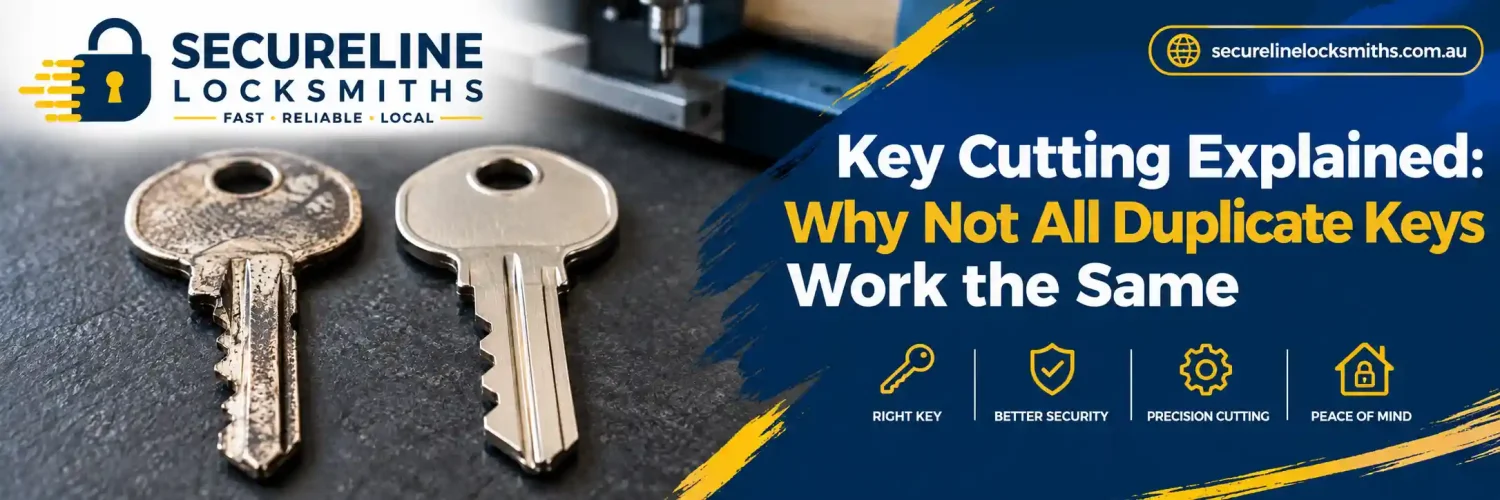
A duplicate key that doesn’t quite work properly is a strangely common complaint — it goes into the lock fine, but turning it feels gritty, or it works most of the time except when you’re in a hurry and it really matters. Duplicate key not working smoothly is rarely a coincidence or bad luck; it almost always traces back to something specific in how that copy was actually made. Understanding what separates a genuinely accurate duplicate from a rough approximation explains why key cutting quality varies so much between different providers.
Reason One: The Cutting Method Itself Matters More Than People Assume
Not all key-cutting equipment works the same way. Basic manual duplicating machines trace the profile of an original key mechanically, physically guiding a cutting wheel along the same path as the original’s grooves.
This method is fast and widely available, but it’s inherently prone to small inaccuracies — the tracing stylus and cutting wheel don’t always move in perfect unison, and minor deviations accumulate across the length of the key.
More precise cutting equipment, including computerised systems that cut to exact manufacturer specifications rather than tracing an existing key, produces considerably more accurate results. This is particularly relevant when duplicating from a key that’s already a copy itself, since manual tracing methods tend to replicate — and sometimes worsen — any existing inaccuracy in the key being copied.
Reason Two: Copying a Copy Compounds Small Errors
Every time a key gets duplicated from an existing copy rather than an original, any small inaccuracy in that copy carries forward into the next one, and manual tracing methods in particular tend to introduce their own small additional deviation on top of whatever was already there. After a few generations of copying copies, the accumulated drift can be enough to genuinely affect how smoothly the key operates, even though each individual copying step seemed reasonable on its own.
This is why a key that’s been duplicated multiple times over several years — a common household reality once several family members have each had spares cut at different points — often performs noticeably worse than a fresh cut taken directly from the original or from precise manufacturer specifications where available.
A Practical Habit Worth Adopting
Where possible, always duplicate from the original key rather than an existing copy, and keep the original itself for everyday use rather than the copy, since the original hasn’t accumulated any generational cutting drift.
Reason Three: Key Blank Quality Varies Considerably
Before any cutting happens, the blank itself matters. Cheaper, lower-quality key blanks sometimes use softer metal alloys that wear down faster once in regular use, or have slightly inconsistent dimensions straight out of the packet compared to the precise specifications a lock’s manufacturer originally designed for.
A technically accurate cut on a poor-quality blank can still result in a key that doesn’t perform as well as it should, simply because the underlying material or base dimensions weren’t quite right to begin with.
Reputable key cutting services generally use quality blanks matched specifically to your lock’s brand and type, rather than a generic universal blank that happens to fit the general shape but doesn’t precisely match the manufacturer’s original tolerances.
Reason Four: Some Locks Have Tighter Tolerances Than Others
Higher-security lock brands, and certain lock types generally, are manufactured with genuinely tighter internal tolerances than a basic, entry-level lock. This means the acceptable margin for error in a duplicate key is considerably smaller for these locks — a minor cutting inaccuracy that a basic lock would tolerate without issue might cause a genuinely noticeable problem in a lock built to tighter specifications. This isn’t a flaw in the higher-security lock; it’s actually part of what makes it more resistant to picking and manipulation in the first place, but it does mean key cutting accuracy matters proportionally more for these locks.
If you have a higher-security lock system, it’s particularly worth using a service with precise, modern cutting equipment rather than a basic manual duplicator, given how much less margin for error these locks genuinely have.
Reason Five: Restricted and Patented Key Systems Work Differently Entirely
Some lock systems use restricted or patented key blanks that can’t legally be duplicated at just any hardware store or key-cutting kiosk, precisely because the blank itself is controlled and only available to authorised dealers. If you’re dealing with one of these systems and attempting to have a copy made somewhere unauthorised, you may encounter a provider using an incompatible generic blank that only loosely approximates the correct shape — which explains a duplicate that seems to work but performs noticeably worse than the original.
Checking whether your specific lock uses a restricted key system, and sourcing duplicates only through an authorised channel, avoids this problem entirely rather than settling for an approximate, non-genuine blank.
What This Means When You’re Getting a Key Cut
Understanding these factors changes what’s actually worth asking about before you commit to a particular key-cutting service. Whether they cut from the original key rather than an existing copy where possible, what type of equipment they use, whether the blanks they stock are matched specifically to your lock’s brand, and whether your particular lock uses a restricted system that limits where a genuine duplicate can even be sourced — these questions matter considerably more to the eventual result than simply finding the fastest or cheapest available option.
Signs a Previous Duplicate Might Be the Problem
If you’ve been dealing with a key that requires extra effort, occasionally sticks, or works inconsistently, it’s worth considering whether the key itself — rather than the lock — is actually the source of the problem. Comparing the suspect key’s teeth pattern closely against a known-good original, where you still have one, sometimes reveals visible inconsistencies in depth or spacing that explain the inconsistent performance entirely, without needing to assume the lock itself has developed a fault.
Testing a New Duplicate Before You Rely On It
A properly cut key should turn smoothly and consistently on its very first use, without needing to be “worked in” over time. If a fresh duplicate feels rough or inconsistent straight away, that’s a genuine sign worth raising immediately with whoever cut it, rather than assuming it will simply improve with use. A reputable key cutting service will generally test a freshly cut key in your lock before you leave, precisely because this immediate check catches most cutting inaccuracies before they become an ongoing inconvenience.
It’s a reasonable expectation to ask for this test explicitly if it isn’t offered automatically, particularly for a key you’re planning to rely on regularly rather than keep purely as an emergency backup.
Why This Matters More for Some Keys Than Others
Not every key needs the same level of precision. A rarely used spare kept purely for emergencies has more tolerance for minor imperfection than a key you’ll be using multiple times daily.
For your primary, everyday keys, it’s worth prioritising a properly sourced original-quality duplicate over the cheapest or most convenient option, given how much more that key’s performance will actually affect your daily experience compared to an emergency backup that mostly just sits in a drawer.
This distinction also applies to keys shared with contractors, cleaners, or occasional visitors, where the frequency of use is genuinely lower and a moderate-quality duplicate is usually a perfectly reasonable choice, freeing up the higher-quality, freshly sourced copies for the keys your household actually relies on day in and day out.
Conclusion
Duplicate key not working properly is rarely random bad luck — it almost always comes down to one of a handful of specific, identifiable factors: the cutting method used, whether it was copied from an original or another copy, the quality of the blank itself, how tight your specific lock’s tolerances are, and whether a restricted key system is involved. Understanding these factors means you can make a genuinely informed choice about where and how you get keys cut, rather than treating every key-cutting service as functionally identical.
A slightly higher-quality cut, taken properly from an original key using appropriate equipment and a matched blank, tends to perform reliably for years — while a rushed, low-quality duplicate can cause ongoing frustration that’s entirely avoidable with the right approach from the start.